16,600
Logistics and evacuation missions completed in June 2026 — up 18.6% from May
22,000
UGVs contracted for delivery in 2026
Capabilities
01 / 06
DOZOR AI Sector Detection
Ammunition
Kinetic ammunition systems
Different kinetic countermeasures run in the same complex, extending the coverage zone across the full engagement envelope.
Anti-drone charges
Purpose-built rounds tuned specifically for the FPV threat class.
Tied shot
Bound buckshot that holds a wider, denser pattern in flight.
Mortar primer
High-energy primer charge for close-range knockdown.
Net launcher
Deploys a capture net to disable rotors without a kinetic kill.
Sensor & AI
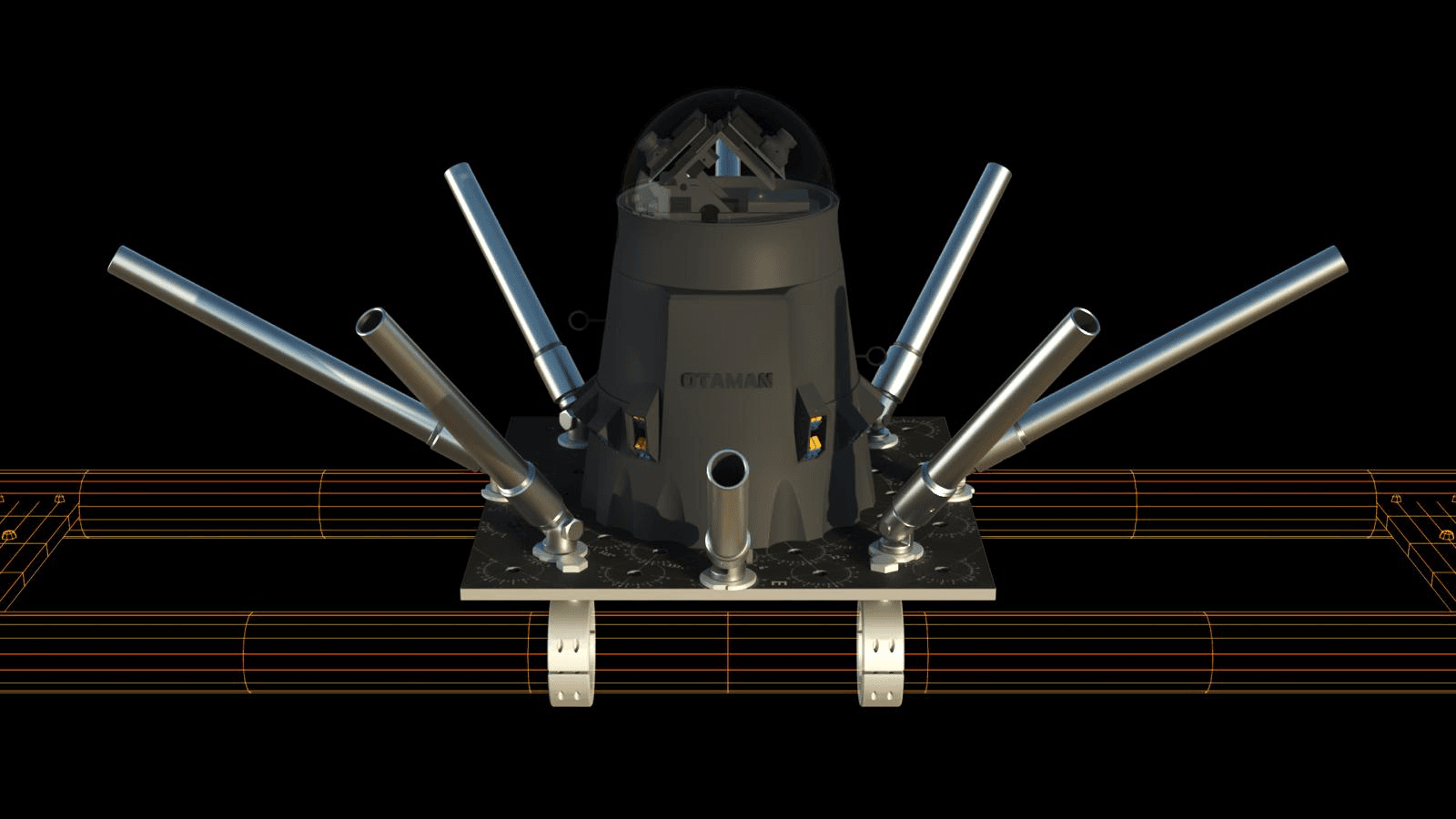
VEZHA sensor module
Every Otaman turret carries an independent VEZHA sensor block — the eyes that drive a sector before a single round is fired.
180° sector sweep
Independent vertical and horizontal servo drive sweeps and tracks the target through the full engagement arc.
Track & auto-fire
Locks onto the threat and fires automatically once it enters the effective engagement distance.
Self-cleaning dome
An automatic cleaning system keeps the observation dome clear in the field.
RF & acoustic add-ons
Optional radio-frequency and acoustic detectors extend the detection envelope beyond optical and thermal.
Purpose-built AI models
VARTA's own computer-vision models, trained on real and synthetic data and tuned to pick out small aerial targets, refined through the Palantir and Brave1 data-room programs.
Ground defense
Extends monitoring to the area around the UGV itself, not just the sky above it.
The engagement sequence
From detection to kinetic interception, Otaman closes the loop without waiting on a human trigger.
Detection
Two DOZOR AI sensor blocks scan continuously for FPV threats out to 80 meters, classifying every object before any engagement decision.
Technical Overview & Applications
FPV drones are now one of the most effective ways to destroy vehicles on the battlefield. Ground robotic complexes, logistics transport, evacuation vehicles, and light combat platforms are especially exposed. Classic electronic warfare is losing ground against fiber-optic FPVs, autonomous drones, and drones that simply wait for a target — and automatic turrets remain expensive with a mechanical slew delay that costs precious seconds.
Otaman is VARTA's answer: a modular active-protection complex for UGVs that fuses DOZOR AI computer vision with VARTA DroneHunter kinetic interception. Once a threat is detected, the system determines the attack direction on its own and activates only the sector that needs to fire — if an operator faces a double-attack tactic, Otaman activates the neighboring modules in sequence.
Each VEZHA sensor block rotates 180 degrees, tracking and auto-firing within the effective engagement distance, driven by independent vertical and horizontal servos. The dome has a self-cleaning system to keep the sensor clear, and the platform supports optional RF and acoustic detector integration for full autonomous, round-the-clock sky monitoring.